
How We Review Dense-Compute Systems
The hardware, power, cooling, monitoring, ownership, and stop-condition questions we review before accepting a dense-compute system.
- Published
- Filed under
- capacity
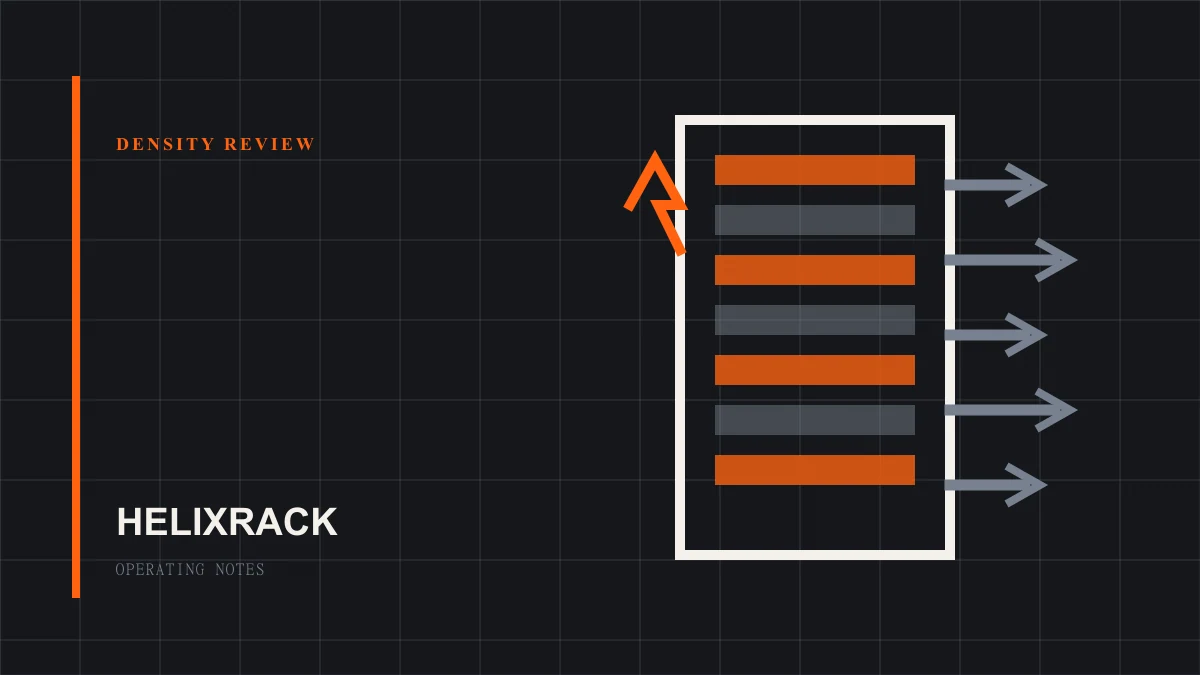
Rack height alone is not a useful acceptance test for an accelerator system. The complete configuration has to fit the available power path, airflow, weight, cabling, monitoring, and response plan.
Start with the exact machine
“GPU server” is not a sufficient specification. A fit review needs the manufacturer and model, installed accelerator and power-supply configuration, dimensions, weight, input requirements, likely steady and peak draw, airflow direction, network interfaces, and remote-management method.
Those details are checked against a particular rack position and operating envelope. Approval for one configuration does not carry over to another chassis or to a later hardware change.
Prepare the test before arrival
The request also needs an owner on each side, a proposed window, a workload description, and the conditions required to start. We identify which facility signals are available, which workload signals the customer will watch, how the system will be brought up, and what observation is needed before the trial can continue.
Receiving instructions follow that review. Arrival at the facility does not authorize installation or energization. If the delivered chassis, internal configuration, rails, cabling, or power requirements differ from the approved request, the trial pauses while we evaluate the change.
Agree on what the trial will measure
A useful trial defines the questions before the system goes live. Depending on the request, those questions may include:
- whether the assigned power path supports the observed load and failure case;
- whether inlet and exhaust behavior stays within the approved thermal envelope;
- whether the system affects neighboring equipment or maintenance access;
- which facility signals will be monitored; and
- who may authorize a change, shutdown, or recovery action.
Facility reachability is not the same as application health. Helixrack can monitor the agreed facility-side signals, while the customer remains responsible for workload behavior, data, software, and recovery decisions.
Watch the boundary, not only the average
A trial needs limits that operators can act on. The plan should identify the conditions that require a workload reduction, a controlled shutdown, or a review before continuing. It should also name who can authorize each action and how the customer will be reached if the system crosses the agreed boundary.
Average draw or temperature can conceal short changes that matter to a dense placement. The useful record pairs readings with time, workload state, maintenance activity, alerts, and operator actions. That context helps distinguish a repeatable operating pattern from a single observation and keeps a facility measurement from being mistaken for an application result.
End with a placement decision
At the close, we compare the observations with the questions and limits agreed at the start. The result may support continued operation of that exact configuration, a revised placement, another bounded test, or removal. The decision records its scope so a later upgrade starts with the right assumptions instead of inheriting approval automatically.
Keep the approval bounded
A trial is permission to evaluate the documented system under agreed conditions. It is not a general capacity promise, an availability guarantee, or approval for every machine in the same product family.
If you are planning a dense system, send the exact configuration through Helixrack.com before purchasing shipping or arranging delivery. We will confirm whether a review is possible with current capacity.