
What a Planned Manual Power Transfer Taught Us
A July 2023 attended test clarified the roles, stop conditions, observations, and handoffs needed for planned backup-power work.
- Milestone
- Published
- Updated
- Filed under
- field note
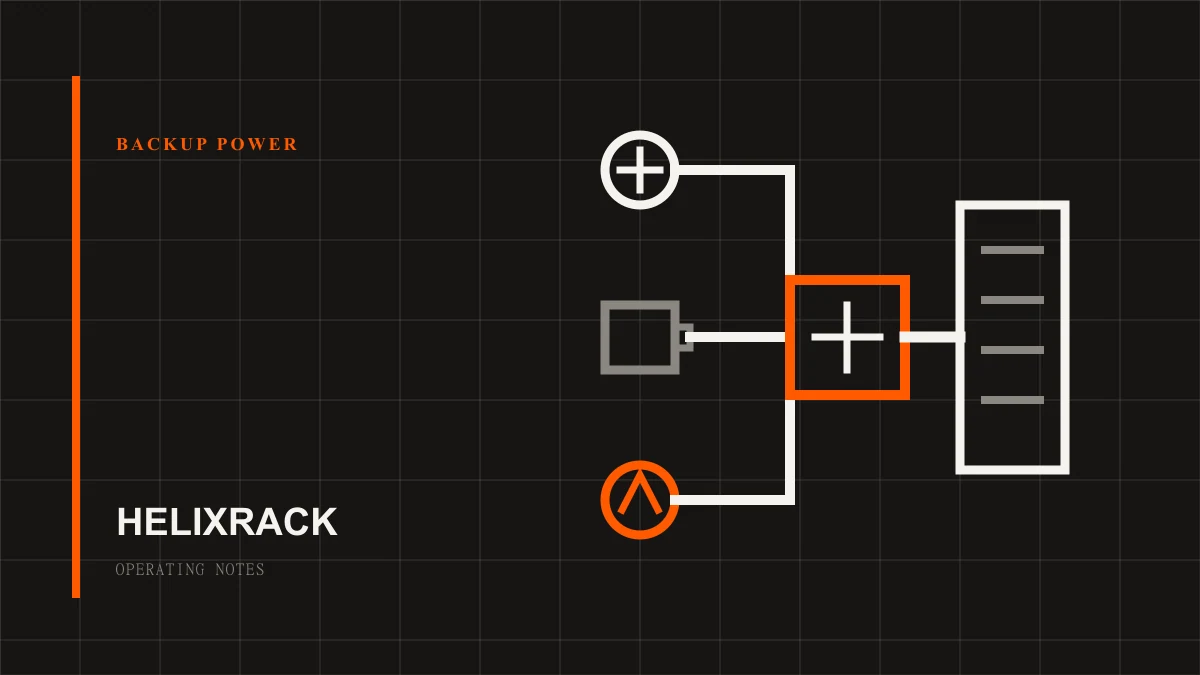
On July 4, 2023, Helixrack completed an attended manual power-transfer test. The evaluated sequence moved the protected facility load from its normal utility input to a staged generator source, using stored energy as the bridge, and then returned the system to normal service.
The test completed without an observed loss of facility-side protected output. No customer interruption was reported, and customers did not need to take action. The most valuable result was a clearer procedure for every later power change.
What we observed
The alternate source was connected, stabilized, and checked before the transfer began. During the evaluated sequence, operators recorded the source state, protected output, stored-energy condition, and test clock at each decision point.
The observations applied to the specific path, load, equipment state, and procedure tested that day. A general availability percentage or a different load and configuration sat outside that result.
That boundary also separated facility results from workload results. Helixrack could observe continuity at the protected output, while customers remained responsible for monitoring applications, operating systems, and services elsewhere in the stack.
Customer impact
The protected facility-side output remained available during the planned change and return. The next-day impact review found no reported interruption associated with the test, and no customer action was required.
Recording that finding separately mattered. Customer workload monitoring remained a separate responsibility, and the absence of a customer report left the test bounded to the path and conditions actually observed.
Safety and stop authority
The work was attended and controlled by a qualified electrical lead. Only authorized personnel operated facility power equipment. The plan named who could proceed, who could stop the test, which prerequisites had to be present, and which observations required an immediate return to the approved safe state.
The public description intentionally omits switching instructions, protection settings, connection details, and operating thresholds. Customers and visitors should never attempt to operate Helixrack distribution or transfer equipment. Any approved remote-hands work remains within the written service scope and the qualifications required for the task.
Corrective action after the test
The result led to a revised operating procedure rather than a broad reliability claim. The revised procedure uses six controls:
- Identify the normal source, alternate source, and protected load in scope.
- Confirm monitoring, communications, and qualified staff before proceeding.
- Name the person with decision and stop authority.
- Define the expected observation and stop condition for each change.
- Record each transition and return against the test clock.
- Reconcile the final physical state with the operating record.
This sequence made it acceptable to stop before a transfer when a prerequisite was missing. It also prevented a successful engine start, stored-energy check, or source connection from being treated as proof of the complete end-to-end sequence.
What the test adds to planning
Staff presence and preparation are now explicit design inputs. Protected-power reviews consider the people, instruments, communications, fuel, grounding, cabling, load behavior, equipment condition, and stored-energy state required for the planned work.
The test also reinforces a reporting rule: describe only the configuration and conditions actually evaluated. Placement decisions begin with the complete server configuration, not the result of a different test. Send the chassis, input requirements, expected and peak draw, and power-supply details through Helixrack.com for a fit review.
August update: permanent automatic transfer
The manual test was an interim arrangement, not the final power design. On August 17, 2023, a licensed electrical contractor commissioned a permanent 30 kW diesel generator and automatic transfer switch for the protected facility load. The commissioning test transferred in eight seconds and returned the system to normal utility service under the approved sequence.
That later installation removed the need for an operator to complete the normal source transfer by hand. The single commissioning result remained bounded: generator starting condition, fuel, transfer controls, UPS batteries, connected load, and recurring test records remain part of the operating boundary.